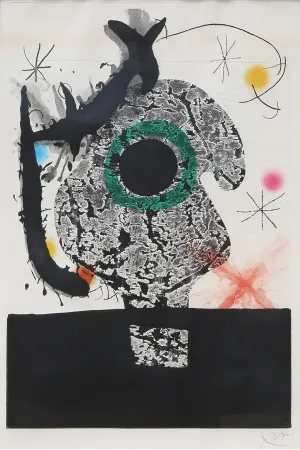
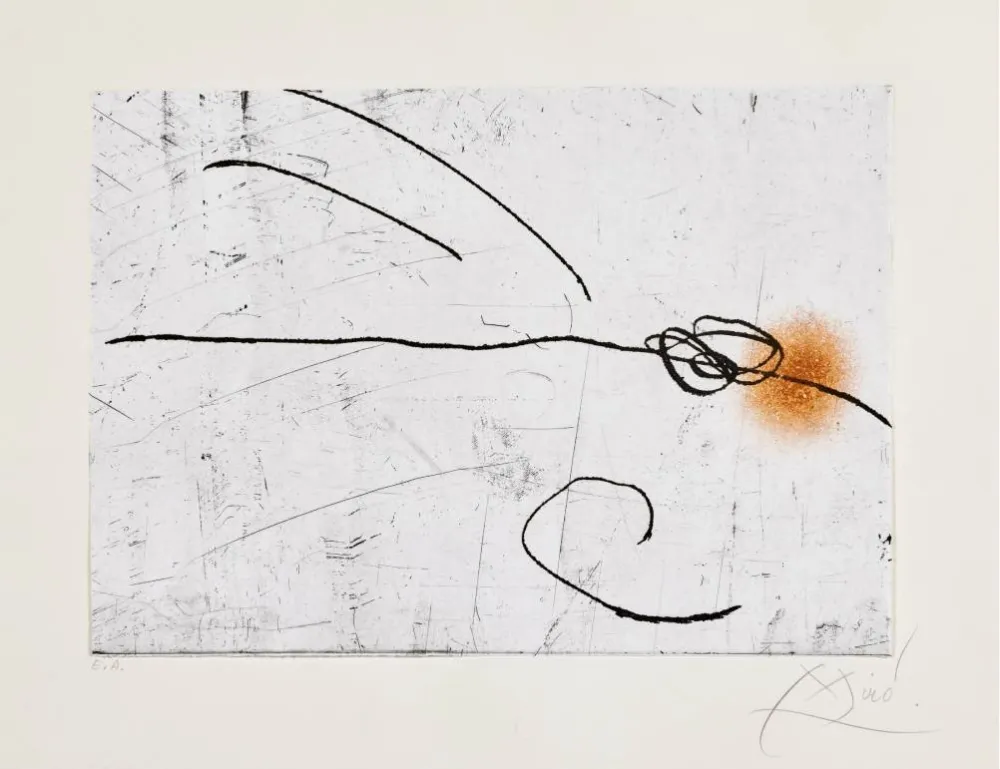
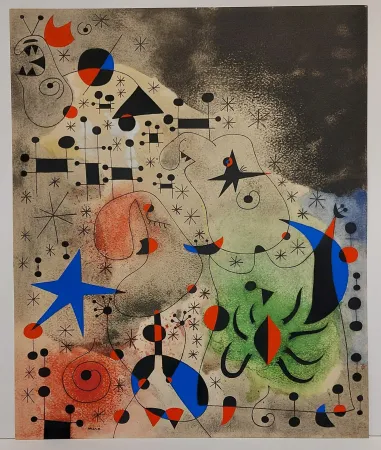
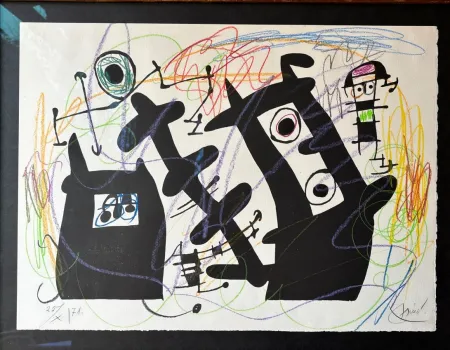
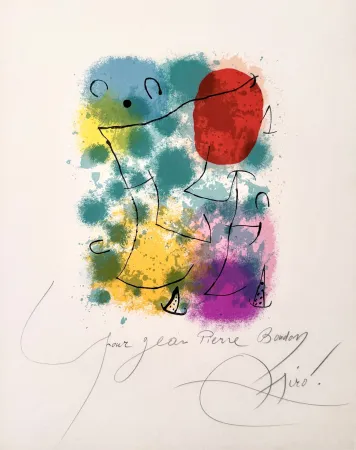
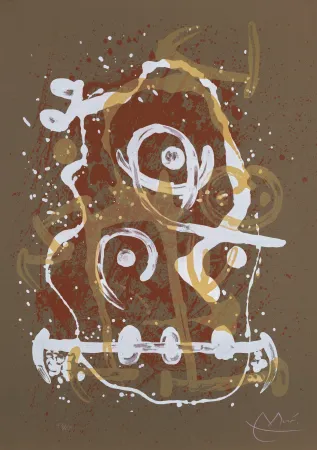
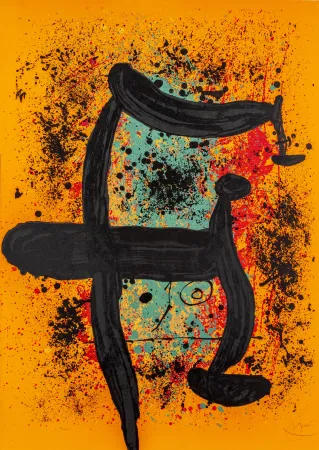
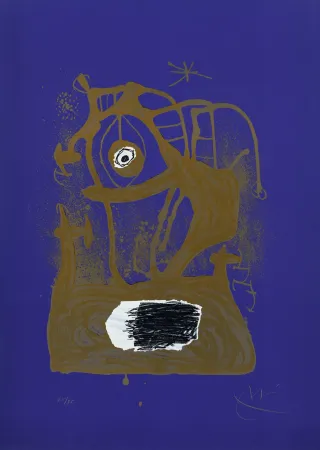
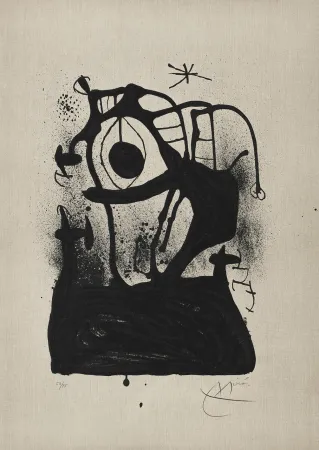
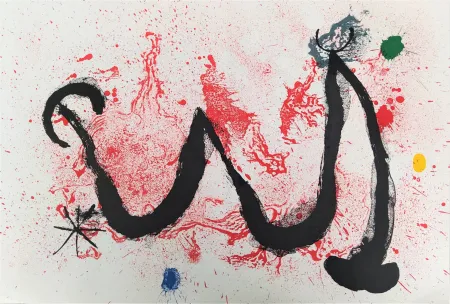
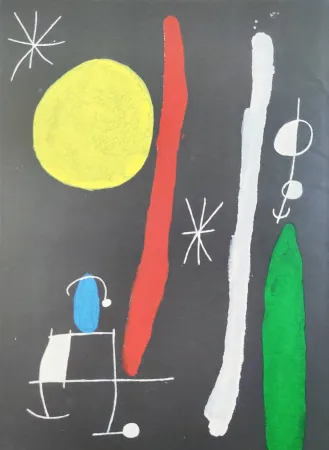
Etching and aquatint from 1981.
The edition E.A. printed with large margins on Guarro Extra Blanc paper and mounted onto Arches vellum paper..
Dimensions of work: 56.5 x 76.5 cm.
Hand signed.
Publisher: Maeght, Barcelona.
Reference: Dupin 1144.
The work is in Excellent condition.
--
Joan Miró’s Lapidari (1981) takes its title from the idea of a “lapidary”—a carved or engraved inscription on stone—and translates this concept into the artist’s own abstract visual language. Instead of depicting stone directly, Miró responds to the spirit of lapidary art: the clarity of the mark, the permanence of the gesture, and the sense that each line carries weight and intention, as if carved into a surface meant to endure.
The work combines etching and aquatint, two techniques that naturally echo lapidary qualities. The etched lines resemble incisions, sharp and deliberate, while the soft aquatint areas evoke the textured surfaces of ancient tablets. The result is an image that feels both modern and archaic—like a fragment of a symbolic language that could have been discovered on a stone wall or monument.
This example comes from the E.A. edition, printed with large margins on Guarro Extra Blanc paper, a bright, smooth sheet ideal for showing the contrast of Miró’s marks. It was then mounted onto Arches vellum paper, a common practice for high-quality artist proofs published by Maeght in Barcelona. The print measures 56.5 × 76.5 cm, is hand-signed, and is catalogued as Dupin 1144.
Kept in excellent condition, the work preserves the strength of its etched lines and the vibrancy of its colour fields. Lapidari beautifully shows how Miró could take an ancient idea—engraving in stone—and reinterpret it in a poetic, abstract, and unmistakably modern way.